
Last Updated: 1 November 2026
Quick Summary
Early years education in a nursery is the care, play and planned learning a child receives before compulsory school begins, typically from birth to about age five. Settings in England follow the Early Years Foundation Stage, which shapes how the day is organised and how children’s progress is observed and recorded.
- Early years provision covers children from birth to the start of Reception, usually around their fifth birthday.
- The EYFS groups learning into seven areas, three of them prime: communication and language, physical development, and personal, social and emotional development.
- Practitioners observe children through play and record progress in a learning journey rather than testing them formally.
- Check the latest inspection report, staff-to-child ratios, and a clear breakdown of fees before choosing a setting.
- Ask for a gradual settling-in process with a key person before your child spends longer periods away.
Table of Contents
- What Early Years Education Means in a Nursery
- The Early Years Foundation Stage in Practice
- The Seven Areas of Learning and Development
- Learning Through Play in Nursery
- Nursery Support for Children with Additional Needs
- Choosing an Early Years Setting for Your Child
- Booking a Visit and Your Child’s First Steps at Nursery
- Frequently Asked Questions
Early years education in a nursery is the foundation on which a child’s later learning is built, and for many parents in South Wales it is their child’s first formal learning experience. This guide sets out what early years education means in practice, what to expect from a setting, and how to choose confidently.
What Early Years Education Means in a Nursery
Early years education is the combination of care, play and planned learning that a child receives before compulsory school begins. In a nursery it looks like a day built around routines, relationships and purposeful activity rather than a timetable of lessons.
Young children learn best when they feel safe, know the adults around them, and have time to explore. A good setting balances these elements so care and education are never treated as separate.
The age range covered, from birth to school entry
Early years provision covers children from birth to the start of Reception class, usually around their fifth birthday. Nurseries may take babies from a few months old, toddlers and pre-school children, each with different needs: babies rely on close one-to-one care and responsive interaction, while older children are ready for more group activity and early literacy and numeracy.
The role of nurseries, pre-schools and childminders
Nurseries, pre-schools and childminders all provide early years education but are organised differently. A day nursery typically offers full-day care across the working week. A pre-school usually runs part-day sessions, common for children aged around three and four. A childminder works from home with a small group, offering a more intimate setting. The right choice depends on working hours, the child’s age and how much group environment suits them.
The Early Years Foundation Stage in Practice
Early years providers in England follow the Early Years Foundation Stage (EYFS), the statutory framework setting standards for learning, development and care from birth to five (Early years foundation stage (EYFS) statutory framework).
For parents, the EYFS matters because it describes good practice in concrete terms: children’s learning must be observed, recorded and used to plan next steps, and the environment must support every child to learn.
The seven areas of learning and development
The EYFS groups children’s learning into seven areas. Three are described as prime areas, which are considered the foundation for the others: communication and language, physical development, and personal, social and emotional development. Four are specific areas: literacy, mathematics, understanding the world, and expressive arts and design.
Parents do not need to track each area separately, but it helps to know what they cover. Communication and language includes listening, speaking and building vocabulary. Physical development covers both gross motor skills, such as climbing and running, and fine motor skills, such as holding a pencil.
How assessment works in practice
The EYFS requires practitioners to observe children as they play and learn rather than test them formally. A practitioner might note a new word, a child sharing a toy, or a child putting on their own coat.
At the end of the Reception year, teachers complete the Early Years Foundation Stage Profile, summarising each child’s development against the early learning goals (Early years foundation stage profile handbook).
What families can expect day to day
In practice, the EYFS looks like a nursery day built around routines, relationships and purposeful activity. Children have regular access to free-choice play and adult-led activities.
A practical test is to ask a setting to show you how a practitioner records a child’s achievements and what they do next with that information. Ask how observations are shared with you, an online journal, daily chat or regular meetings, and whether you can contribute information from home.
When you visit, ask to see a sample learning journey or observation record. A setting that can talk you through how it uses observations to plan next steps is demonstrating the EYFS in action.
The Seven Areas of Learning and Development
The EYFS groups children’s learning into seven areas. Three are described as prime areas, which are considered the foundation for the others: communication and language, physical development, and personal, social and emotional development. Four are specific areas: literacy, mathematics, understanding the world, and expressive arts and design. These specific areas rely heavily on the secure base provided by emotional and social learning, which fosters the confidence children need to explore their surroundings and engage with their peers.
Parents do not need to track each area separately, but it helps to know what they cover. Communication and language includes listening, speaking and building vocabulary. Physical development covers both gross motor skills, such as climbing and running, and fine motor skills, such as holding a pencil. Personal, social and emotional development is about confidence, relationships and managing feelings.
Learning Through Play in Nursery
Play is the main way young children learn, and well-planned nursery play is purposeful rather than random.

Look for a nursery where children have regular access to free-choice play and adult-led activities. Free play lets children follow their own curiosity, while adult-supported activities introduce new skills and ideas.
FIND OUT MORE ABOUT OUR NURSERIES →
A common mistake when visiting a nursery is judging quality by how tidy or quiet the room looks.
Nursery Support for Children with Additional Needs
Every child in an early years setting has the right to be supported to learn and take part, including children with additional needs or a developmental delay. Read our guide to nursery support for children with additional needs for a fuller picture of what settings provide.
When you visit, ask how the setting supports children with additional needs, who coordinates this support, and how they work with professionals such as speech and language therapists or health visitors.
Building a plan with parents from the start helps ensure that the support a child receives is shared, consistent and reviewed as they grow. If your child has additional needs, bring any reports you already have and talk openly about what helps them at home.
Choosing an Early Years Setting for Your Child
Choosing a setting balances practical needs with how your child responds to the environment. Start with what you cannot change: working hours, days needed, travel time and cost. Then assess quality. A practical checklist helps you compare settings on what matters most rather than relying on first impressions.
Safeguarding and welfare
Every setting should have clear safeguarding procedures. Ask who the designated safeguarding lead is, how staff are trained, and what happens if a concern is raised. Ask about policies on mobile phones and cameras, nappy changing and intimate care, and how visitors are managed. A reputable setting will welcome these questions and answer them directly.
Staff-to-child ratios and qualifications
Ratios determine how much individual attention your child receives. In England, the EYFS sets minimum staff-to-child ratios, which vary by age group. Check current requirements with the relevant regulator, as ratios are subject to change. In Wales, ratios are set by the Welsh Government’s framework. Ask what ratios the setting actually works to, since some exceed the minimum, and about staff qualifications, paediatric first aid, safeguarding training and ongoing professional development.
Inspection reports
Check whether the setting is registered and inspected. Early years providers are registered and inspected by the relevant regulator for their country, and inspection reports are published online (Find an Ofsted inspection report). Read the most recent report and note what it praises and what it asks the setting to improve. A single grade does not tell the whole story, but it is a useful starting point.
Settling-in and communication
A good settling-in process helps your child build a bond with their key person before spending longer periods away. Ask how the setting handles settling-in, whether visits are gradual, and how they keep you informed during the day. Ask whether you receive daily updates, whether there is an online journal, and how quickly you can expect a response if you have a concern.
Inclusion and additional needs
Every child has the right to be supported to learn and take part, including children with additional needs or a developmental delay. Ask how the setting identifies needs early, who coordinates support, and how they work with other professionals such as speech and language therapists or health visitors. Find out how staff are trained and how the nursery communicates progress and any changes to the plan.
Funding, eligibility and costs
Funding can significantly reduce the cost of early years education. Eligible families may access government-funded childcare. Eligibility rules change, so check current criteria with the relevant government and your local council before applying, and confirm how funding is applied to your fees.
Nursery fees vary by setting, age of child and hours booked. Our article on what nursery fees include and what they don’t sets this out in detail.
Use this checklist when comparing settings: safeguarding procedures, staff-to-child ratios, staff qualifications and first aid, most recent inspection report, settling-in process, communication with parents, inclusion and additional needs support, and a clear breakdown of fees and funded hours.
The table below sets out the main things to check when comparing settings, drawn from the points covered above.
| Check | What to ask | Why it matters |
|---|---|---|
| Safeguarding | Who is the designated safeguarding lead? | Shows how concerns are handled |
| Staff-to-child ratios | What ratios does the setting work to? | Sets how much individual attention your child gets |
| Staff qualifications | Paediatric first aid and safeguarding training? | Confirms staff are trained for the job |
| Inspection report | What did the latest report praise or ask to improve? | Gives an independent view of quality |
| Settling-in | Are visits gradual, with a key person? | Helps your child build a bond before longer days |
| Communication | Daily updates or an online journal? | Keeps you informed about your child’s day |
| Inclusion | How are additional needs identified and supported? | Ensures every child can take part fully |
| Fees | What is included and charged separately? | Avoids surprise costs |
Booking a Visit and Your Child’s First Steps at Nursery
The best way to judge a setting is to visit in person, ideally during a normal session so you can see the daily routine.
When your child starts, expect a settling-in period.
Visits can be arranged, and our team will be pleased to show you around and answer your questions about how we support children from their first day.
Frequently Asked Questions
What are the seven areas of development?
The seven areas of learning and development in the Early Years Foundation Stage are communication and language, physical development, personal, social and emotional development, literacy, mathematics, understanding the world, and expressive arts and design. The first three are the prime areas and are considered most important in the early years, because they underpin learning in the other four. Practitioners plan play-based activities across all seven areas, so a single session might support several at once. Parents can see how this works by asking the nursery how each area is covered in their child’s day.
Do you need qualifications to work in a nursery?
Early years practitioners are expected to hold a recognised qualification. Staff often build on this with further study and training in areas such as safeguarding, paediatric first aid and additional needs. Experience alongside a qualification matters too, as practitioners apply theory to real children every day. When choosing a setting, you can ask about the qualifications held by the team who will care for your child.
How can a nursery support children with additional needs?
A nursery can support children with additional needs by working closely with parents and carers to understand the child’s strengths and needs, then adapting the environment, routines and activities accordingly. This may include individual support plans, targeted small-group sessions and liaison with external specialists. Inclusion means every child can take part in play and learning with their peers. Ask a prospective setting how it identifies needs early, how it communicates with families and how staff are trained to support children who need extra help.
How can parents support early learning at home?
Parents can support early learning at home through everyday conversation, reading together, singing rhymes and letting children explore safe objects and outdoor spaces. Simple routines such as counting steps or sorting washing reinforce mathematical thinking, while encouraging children to make choices builds independence. Nurseries are glad to share ideas that match what children are doing in setting, so the learning feels consistent between home and nursery. Small, regular activities matter more than long, structured lessons.


Last Updated: 23 October 2026
Quick Summary
Nursery support for children with additional needs is the structured help a setting provides so a child can learn, play and settle alongside their peers, delivered through key-person relationships, adjusted routines and, where needed, external specialists. Every provider must identify and support children with additional needs from the start under the Early Years Foundation Stage statutory framework. You do not need a diagnosis to start helping a child.
- Ask to see how a setting currently supports a child, not how it would in theory.
- A good early years support plan names one or two clear targets and sets a review date.
- Children with additional needs often need longer than two to three weeks to settle in.
- Put anything important in writing and ask for confirmation, as shift handovers can lose messages.
- Ask any setting what is included in the hourly rate and whether support sessions cost extra.
Table of Contents
- What Nursery Support for Children With Additional Needs Actually Looks Like
- Choosing a Nursery for a Child With Additional Needs
- The Early Years Support Plan Explained
- Building a Nursery Settling In Plan That Works
- Working With Nursery Staff as a Team
- Funding, Additional Support and What to Ask About Costs
- Frequently Asked Questions
What Nursery Support for Children With Additional Needs Actually Looks Like
Nursery support for children with additional needs is the structured help a setting provides so a child can learn, play and settle alongside their peers, delivered through key-person relationships, adjusted routines and, where needed, external specialists. The Early Years Foundation Stage statutory framework requires every provider to identify and support children with additional needs from the start.
In practice, that means a named key person who knows the child well, a room layout that works for their sensory and mobility needs, and small adjustments that nobody makes a fuss about. A child who struggles with transitions might get a visual timetable.
What most guides miss is that the support is only as good as the observation behind it. Settings that watch closely and write things down spot needs earlier than those that wait for a diagnosis. You do not need a label to start helping a child.
Choosing a Nursery for a Child With Additional Needs
The right setting answers your questions directly and shows you evidence rather than promising inclusion on a website. When choosing a nursery for a child with additional needs, ask to see how the setting currently supports a child, not how it would in theory.
Look at staff ratios in the room your child would join, how many children with additional needs the setting already supports, and whether the special educational needs coordinator, usually called the SENCO, is a senior member of staff with protected time.
A common mistake is accepting a tour that only shows the best room. Ask to visit at a busy time, watch how staff speak to children who are dysregulated, and check whether the setting has a written policy you can read before you sign anything.
Questions That Reveal How a Setting Really Works
- Who will be my child’s key person, and what happens when they are off?
- How do you record observations, and will I see them?
- What training has the team had on speech, language and sensory needs?
- How do you handle a child who is struggling at drop-off?
- What would you do in the first two weeks if my child does not settle?
The Early Years Support Plan Explained
An early years support plan is a written record of a child’s needs, the adjustments being made and the outcomes everyone is working towards, reviewed on a set cycle. Settings often call it an individual education plan or a targeted learning plan; the name matters less than whether it is specific and current.
A good plan names one or two clear targets, describes what staff will do differently, and sets a review date. A weak plan is a list of labels with no actions attached. Ask to see a blank template before you enrol your child, and ask who writes it.
Who Contributes to the Plan
Parents contribute most. You know the child’s history, what calms them and what has already been tried. The key person contributes day-to-day observations. The SENCO coordinates and, where the child’s needs are more complex, may bring in outside specialists. In some areas, health visitors or early years advisory teachers attend reviews. You should be invited to every review, and you can ask for one sooner if things are not working.
Ask for the plan in writing before the review meeting, not at it. Turning up to a discussion about your child with no time to think produces agreements you may regret. A day’s notice is reasonable.
Building a Nursery Settling In Plan That Works
A nursery settling in plan should be built around your child’s actual patterns, not the setting’s standard timetable. Most children manage short, increasing sessions over two to three weeks. Children with additional needs often need longer, and that is fine.
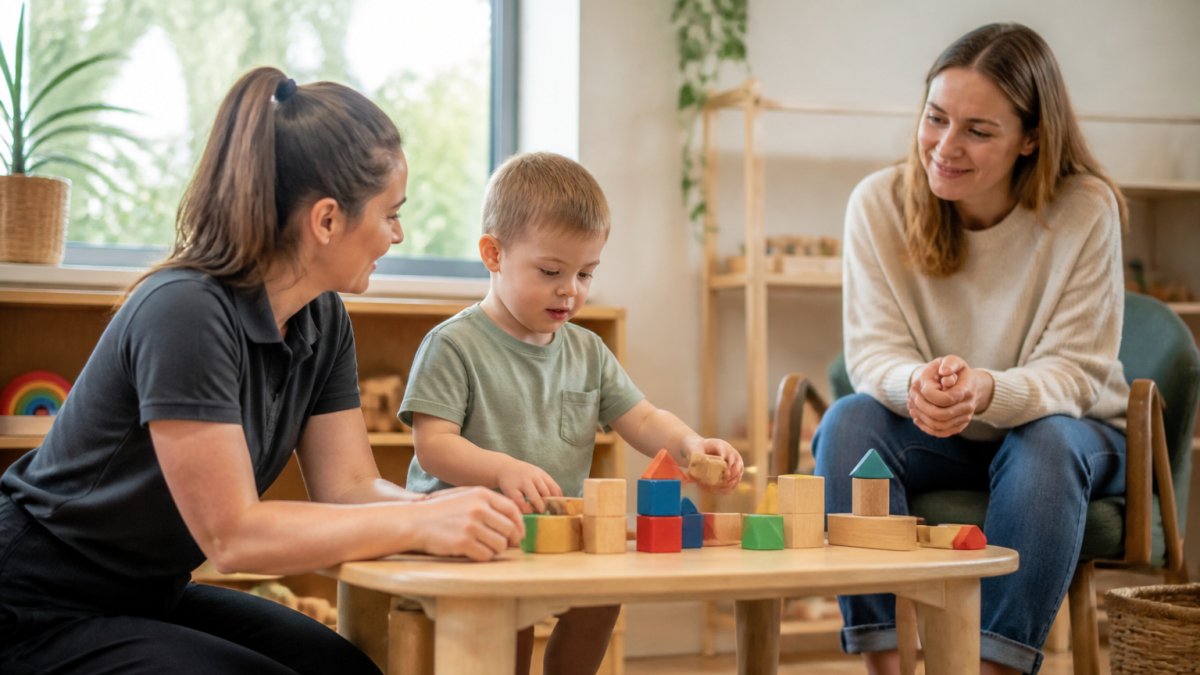
Start with a session alongside you, then a short session without you, then build. Keep drop-off brief and consistent; long goodbyes make things harder for everyone. Send in the comfort object, the familiar cup, the same snack if it helps.
If your child needs a phased entry over a month, ask for it.
FIND OUT MORE ABOUT OUR NURSERIES →
Working With Nursery Staff as a Team
Treat nursery staff as colleagues in your child’s development, not as a service you are buying. The relationship works best when information flows both ways and nobody is keeping score.
Share what has changed at home, what worked at the weekend and what to watch for. Ask what they observed that day. Small daily exchanges beat a formal meeting every half term. Where communication is difficult, agree a home-setting book or a short weekly message so nothing gets lost at pick-up.
Sharing Information Without Overwhelming the Team
Written handovers are more useful than long verbal ones at the door. Keep to what changes behaviour: sleep, illness, medication, family disruption, a new fear. A single page beats a five-page document nobody reads. If your child sees a speech therapist or occupational therapist, ask for their suggestions in writing so the setting can act on them.
Do not assume a message passed to one staff member has reached the key person. Settings have shift patterns and handover gaps. Put anything important in writing and ask for confirmation.
Funding, Additional Support and What to Ask About Costs
Funding routes vary and change, so check current entitlements directly rather than relying on what another parent told you. Some children qualify for additional early years funding because of their needs, and local authorities publish their local offer setting out what is available. The government guidance on help for children with special educational needs and disabilities is the place to start.
At Little Inspirations Day Nursery, we are a registered Flying Start provider and will talk you through which funded hours apply to your child and how they interact with our fees. Ask any setting three things: what is included in the hourly rate, whether additional support sessions are charged separately, and what notice you get of fee changes. Get the answer in writing.
| What to ask | Why it matters | What a good answer looks like |
|---|---|---|
| Which funded hours apply to us? | Avoids paying twice | Clear breakdown of eligible hours |
| Are support sessions extra? | Hidden cost risk | Included, or a stated separate rate |
| How is one-to-one help funded? | Continuity of staffing | Explained source, not a vague promise |
| What notice for fee changes? | Budgeting | Written notice period stated |
The most reliable sign of good additional needs support is not what a setting claims, but whether staff can describe a real child they currently support and exactly what they changed for them.
Frequently Asked Questions
What support can a nursery provide for a child with additional needs?
A nursery can adapt its environment, routines and activities so a child can take part fully. That might mean visual timetables, smaller group sessions, quieter spaces, or one-to-one attention at key moments. Staff may also bring in outside specialists, such as speech and language therapists, and write an early years support plan with targets reviewed each term. Ask any additional needs nursery how it trains staff and how it records progress, because the quality of day-to-day practice matters more than the label on the brochure.
Can a child with additional needs attend a mainstream nursery?
Yes. Most children with additional needs attend mainstream early years settings, and the law expects providers to make reasonable adjustments so they can do so. The question is not whether a mainstream nursery can take your child but whether that particular setting has the staff, training and willingness to adapt. Visit in person, watch how practitioners respond to children who need extra help, and ask directly what experience they have. A setting that hesitates or deflects is giving you useful information.
How can I tell whether a nursery is right for my child?
Watch the room rather than the tour script. Are staff at child height, engaged in play, and patient with children who are struggling? Do they talk about individual children’s progress with specifics? Ask how they handle a difficult moment, such as a child who cannot cope with a busy transition. For choosing a nursery for a child with additional needs, the strongest signal is how openly staff discuss what they find hard and how they solve it, not how polished their answers are.
What should I ask a nursery before my child starts?
Ask who will be your child’s key person and how often that person changes. Ask what training staff have completed on additional needs and sensory differences. Ask how the nursery records progress and how often you will see it. Ask what happens if your child needs extra support, who pays for it, and whether the setting has experience of the local authority’s inclusion funding. Finally, ask what a nursery settling in plan looks like in practice and how many sessions it usually takes.
How can parents and nursery staff work together to support a child?
Consistency is what makes the difference. Share what works at home, including the small details such as how your child signals they are overwhelmed or which words calm them. Ask staff to tell you what they notice during the day, not just at pick-up when everyone is tired. A short notebook, an app message or a five-minute chat at drop-off keeps information flowing. Working with nursery staff works best when it is routine and two-way rather than a conversation that only happens when something goes wrong.
How can a nursery help a child settle in?
A good nursery settling in plan is gradual and flexible. It usually starts with a short visit alongside you, builds to a longer session without you, and only then moves to full days. Staff should follow your child’s home routine where possible, keep comfort objects close, and tell you honestly how the session went. Expect the plan to be adjusted rather than fixed. Children with additional needs often need more visits and more predictability, so ask whether the setting will extend the process if your child needs it.
What information should I share with nursery staff about my child?
Share anything that changes how your child experiences the day: communication style, sensory sensitivities, medical needs, toileting, sleep, food, and the triggers that lead to distress. Also share what helps, because staff need strategies as much as diagnoses. If your child has an early years support plan or reports from a specialist, bring copies. Be clear about who else is involved, such as a health visitor or therapist, and whether you are happy for the nursery to contact them.
How can play support a child’s development at nursery?
Play is how young children learn, and for children with additional needs it is also how skills generalise. A child practising turn-taking with a favourite toy, or repeating a sound during a song, is doing the work that a worksheet cannot replicate. Practitioners break play into small, achievable steps and build on what a child already enjoys. Ask your nursery how they plan activities around your child’s interests, because that is usually where the most progress happens.
Finding a nursery that genuinely welcomes a child with additional needs takes more than a friendly tour. Little Inspirations Day Nursery offers award-winning early years care across South Wales, with over 20 years of experience, an inclusive environment built around individual family needs, and teams who will sit down with you and work through the plan together. Get in touch with Little Inspirations Day Nursery to arrange a visit and see how we would support your child.